
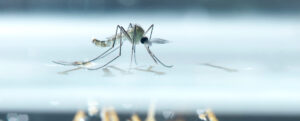
A question frequently asked by clients is why their pond seems to have a mosquito problem. Mosquitoes, like many other insects, undergo their juvenile development in water. Adults lay their eggs on aquatic vegetation, and when the eggs hatch, they enter the water to begin their growth. However, unlike many animals which breath through their mouths, juvenile mosquitoes instead breathe through a tube which extends from their rear. Hanging upside down in the water, mosquito juveniles effectively use the tube as a snorkel. Because of this, juvenile mosquitoes require a fairly still water surface in order to breathe, otherwise the “snorkel” is forced underwater. This is what makes ponds ideal habitats for mosquito breeding—their water is often sheltered and still. The presence of mosquitoes can be a concern for pond owners, not only for the annoyance, but also for the concern of spreading disease. So what can be done to prevent or mitigate their breeding?
The key to limiting mosquito presence lies in making the pond into a habitat which is not ideal for their breeding. This can be accomplished in a few ways: agitation of the water, reducing aquatic vegetation, biological factors, and chemical treatments. Let’s explore each of these!
Agitation of the water: As we learned, juvenile mosquitoes need still water in order to properly use their breathing tubes. If the surface of the water is kept in motion, the mosquitoes should be unable to keep their breathing tubes above water. Adding a fountain can be enough to keep the surface of the water moving. One can also purchase surface agitators and surface aerators which will serve the same purpose. Surface aerators have the added benefit of helping to ensure your fish have enough oxygen in the water!
Reducing aquatic vegetation: Although aquatic vegetation is considered healthy for ponds, it is possible to have too much of a good thing. Apart from the other problems which too much vegetation can present, heavy growth of underwater plants can prevent water from being naturally circulated by wind action. When the water is kept still by too much plant growth, mosquitoes are once again presented with an ideal spot for breeding. Responsible management of aquatic vegetation can help to mitigate this problem.
Biological factors: Although mosquitoes like to feed on humans, they themselves are prey items for many other animals. In order to deal with existing mosquito problems, it can be beneficial to add predator fish to your pond’s ecosystem. Fish feed on mosquito larvae, thus creating a natural remedy to an irritating problem. Other aquatic insects can also act as predators to mosquito larvae, so leaving enough vegetation for healthy development of predator insects can be beneficial. A third option is buying products like Mosquito Dunks, which release bacteria onto the water’s surface which are toxic to many forms of juvenile mosquitoes.
Chemical treatments: Many companies provide mosquito fogging to discourage the presence of adult mosquitoes in your yard. By removing the adults, you are effectively eliminating the possibility of mosquitoes breeding in your pond.
Here we’ve outlined a handful of solutions to mosquito problems in and around your pond. It should be kept in mind that where there is still water, mosquitoes will attempt to congregate, and no solution is going to be 100% effective. However, combining a few methods should help to return your pond to a comfortable state, with limited irritation from mosquitoes!
Emily Huber
Field Biologist and Aquatic Specialist